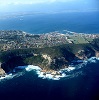


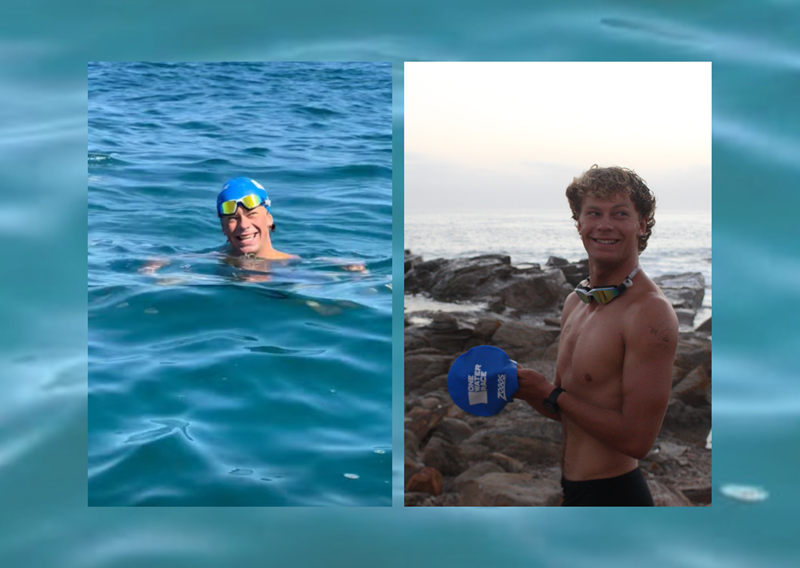
MOSSEL BAY NEWS - Mossel Bay’s Kane Johnstone (19) is getting ready for round two of Project Deep, this time with a 14.2km swim across the bay from Fransmanshoek to Dana Bay’s First Beach.
This swim, all in the name of marine conservation and to raise awareness for the proposed Mossel Bay Shark Catch Exclusion Zone (Scez), is in partnership with local organisation Earth Legacy Foundation.
It is set for Saturday 4 April. Johnstone will start his swim at Fransmanshoek at 06:30 and expects to finish at Dana Bay’s First Beach between 12:30 and 14:00.
This just over a month after the 19-year-old endurance athlete completed a gruelling 22km crossing from The Point to Glentana Beach, on 19 February.
This second swim will also cover the exact area of the proposed Scez.
“This swim directly traces the boundaries of the proposed Shark Catch Exclusion Zone. A localised, practical intervention designed to restrict targeted commercial shark fishing in a critical habitat already showing clear signs of ecological decline,” said Esther Jacobs of the Earth Legacy Foundation.
She said Johnstone did not report seeing any sharks, rays or fish during his 9.5-hour swim in February.
“That absence says everything,” she said.
Mossel Bay Advertiser has previously reported on the plight of white sharks and other protected shark and ray species in Mossel Bay waters.
The decrease in white sharks spotted along the Mossel Bay coast, which is one of three historic hotspots for them in the world, has long been a concern for conservationists and scientists.
Research by experts suggests there are a few threats to our white sharks and other smaller species of sharks in South African waters, including demersal (bottom-dwelling) shark longline fishing.
According to a 2021 document by the Department of Forestry, Fisheries and the Environment, the demersal shark longline fishery operates in waters generally shallower than 100m and uses bottom-set longline gear (1 000 hooks per line) to target demersal sharks.
The fishery operates nearshore from Cape Town to East London and predominantly catches soupfin and smooth-hound sharks.
Additional species include the white-spotted smooth-hound, Carcharhinus species such as the bronze whaler (C. brachyurus), dusky sharks and several skate species.
However, according to a National Biodiversity Assessment published by the South African National Biodiversity Institute (Sanbi) on 13 February, soupfin sharks are critically endangered, and the common smooth-hound shark is endangered.
Jacobs said demersal shark longlining removes tens of thousands of sharks annually, and that the majority of the catch is exported with no benefit to South Africa.
She said the Scez offers a solution that has a low economic impact and is ecologically significant.
“Project Deep has evolved into something far more powerful than a single endurance event. This next swim is a strategic statement, physically connecting the boundaries of the proposed exclusion zone while reinforcing the urgent need for high-impact, practical conservation solutions,” said Jacobs.
Those who would like to meet Earth Legacy Foundation’s team and cheer on Johnstone at his finish line on First Beach are welcome to come out to support him and the cause. Jacobs said they will be doing a clean-up along the coastline while they wait for Johnstone to finish, and she urged the supporters to bring a bag along to join them.
Enquiries: Visit www.earthlegacyfoundation.org or the Facebook page Earth Legacy Foundation.
Previous articles:
- Young Mossel Bay man completes 20.5km open water swim for sharks
- From The Point to Glentana: Date for shark conservation swim is set
- Swimming 20.5k to champion shark protection
- Athlete halfway to his goal in 20.5km swim
‘We bring you the latest Garden Route, Hessequa, Karoo news’