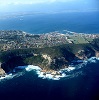


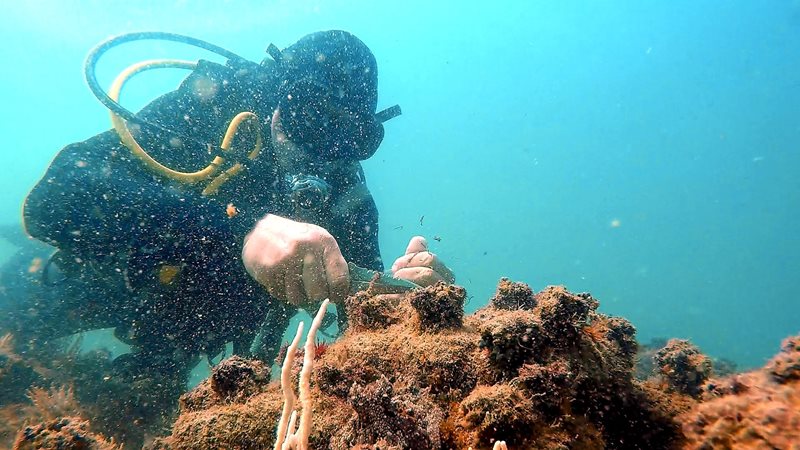
MOSSEL BAY NEWS - Although seemingly pristine on the surface, kilometres of fishing line, hooks, lures and the mutilated remains of smaller shark species can all be found below the waters along parts of Mossel Bay’s coastline.
With over 15km of fishing line, 1 500 sinkers and 600 hooks collected from Mossel Bay’s waters during clean-ups facilitated by non-profit organisation Earth Legacy Foundation in partnership with Go Dive Mossel Bay, over a period of three years, this is just one dire aspect of several critical issues facing not just the marine life in our bay, but waters across the globe.
The decrease in white sharks spotted along the Mossel Bay coast, one of three historic hotspots for white sharks in the world, has long been a concern for conservationists and scientists.
Research by experts suggests there are a few threats to our white sharks and other smaller species of sharks in South African waters, including demersal (bottom-dwelling) shark longline fishing.
According to a 2021 document by the Department of Forestry, Fisheries and the Environment, the demersal shark longline fishery operates in waters generally shallower than 100m and uses bottom-set longline gear (1 000 hooks per line) to target demersal sharks.
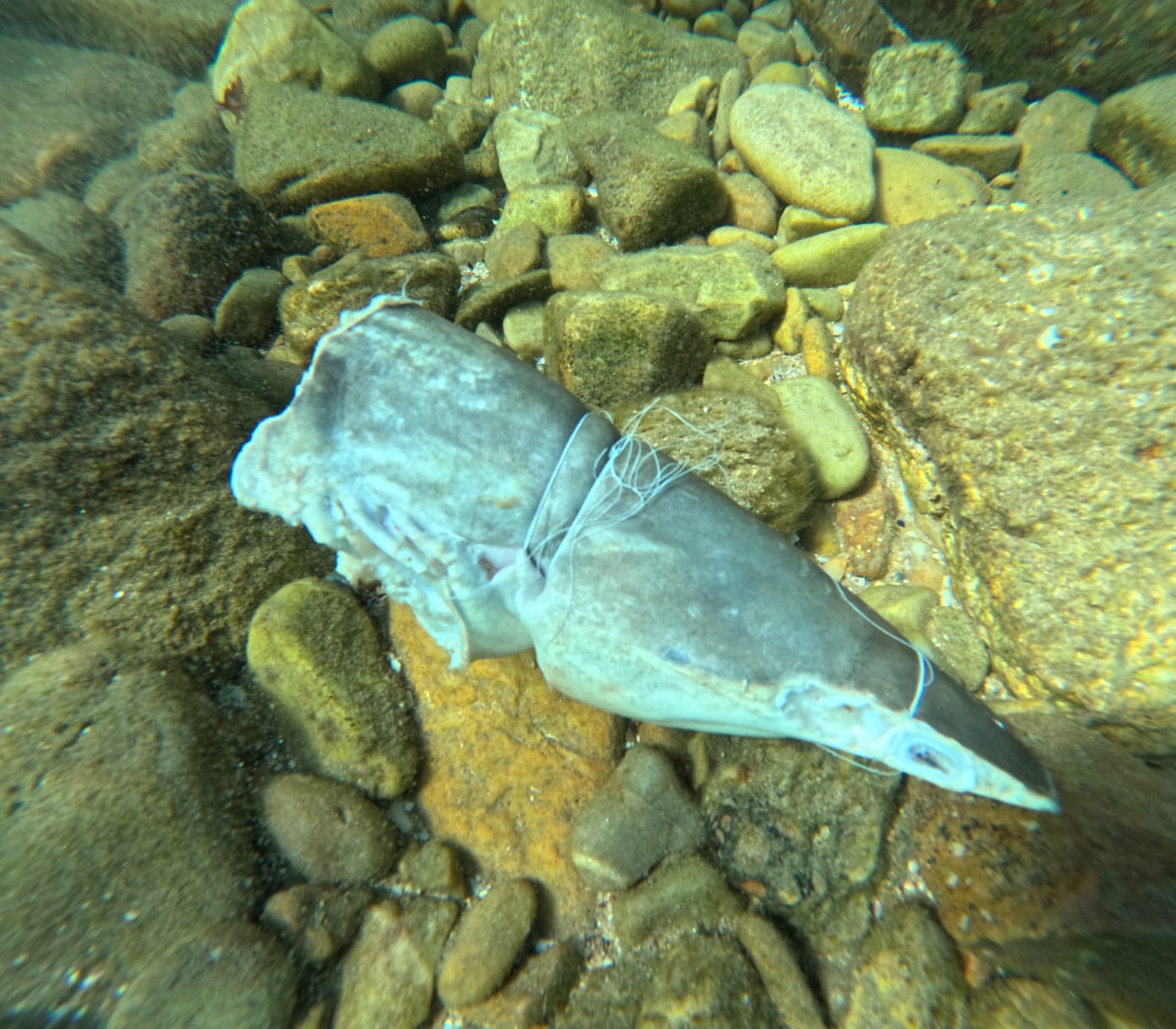 The head of a shark wrapped in fishing line, recently found while diving near The Point. Photo: Devon de Villiers.
The document stated that the fishery operates nearshore from Cape Town to East London and predominantly catches soupfin and smooth-hound sharks.
Additional species include the white-spotted smooth-hound, Carcharhinus species such as the bronze whaler (C. brachyurus), dusky sharks and several skate species.
According to a National Biodiversity Assessment published by the South African National Biodiversity Institute (Sanbi) on 13 February, soupfin sharks are critically endangered, and the common smooth-hound shark is endangered.
Small shark species whose fins and heads have been removed have recently been found in Mossel Bay waters recently, although it is unclear if this is from commercial or recreational fishing in the area.
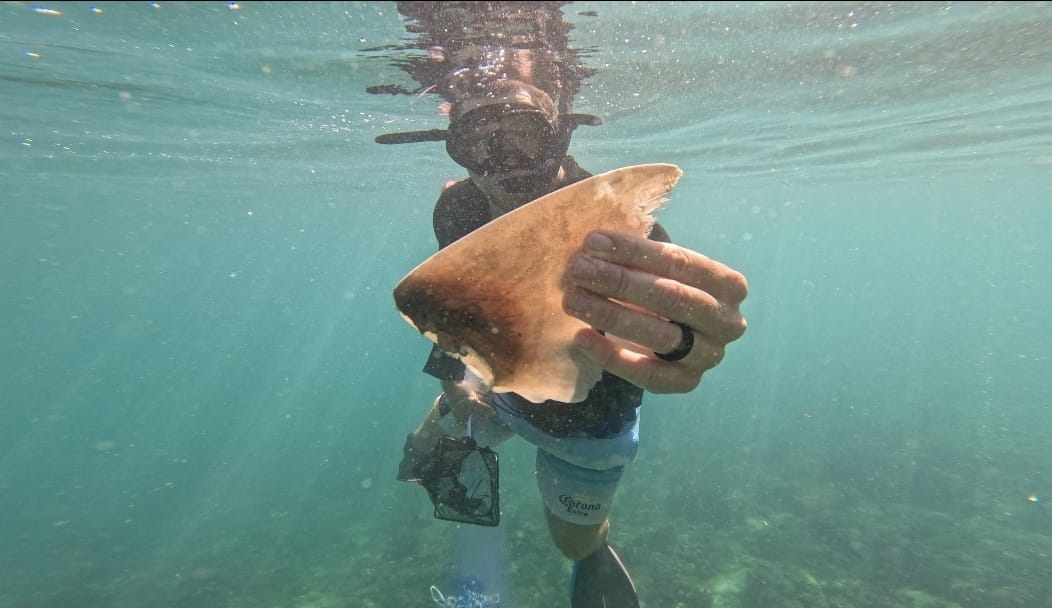 A diver holds up a shark fin recently found in Mossel Bay waters at The Point. Photo: Devon de Villiers
A local, Devon de Villiers, who is an avid diver and frequently snorkels between the harbour and The Point, said he finds the remains of small species of sharks almost every time he dives in that region.
In December, he took footage of a shark's head, possibly a smooth-hound, wrapped in fishing line, and also of a shark fin floating in the water.
He said the reef in that area is covered in tracer line and hooks. "Sometimes we get hooked ourselves when swimming there. It is line from commercial fishing operations and recreational. It is a massive problem."
Another avid diver who often snorkels Mossel Bay waters, Ricardo Roerink, said he has also found some shark remains, as well as live sharks with hooks caught in their mouths.
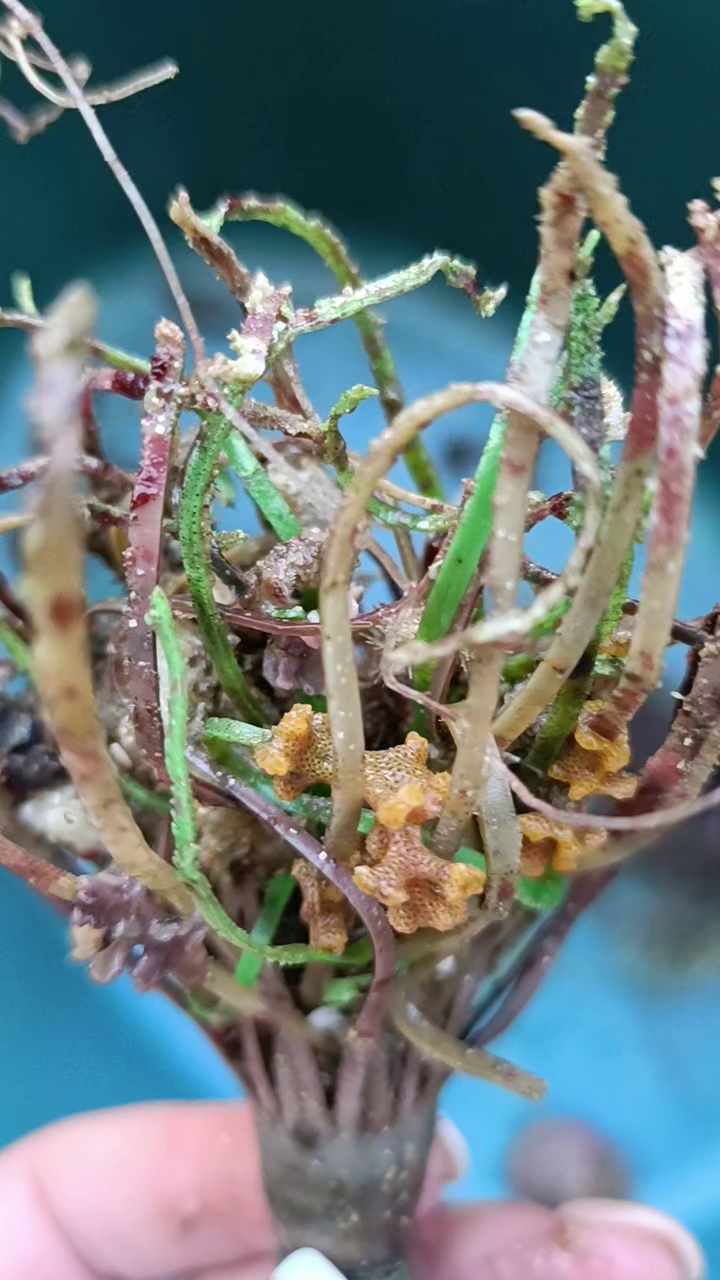 A lure, made to resemble a squid, that has coral and polyps growing on it. Photo: Esther Jacobs/Earth Legacy Foundation
He said he has seen a few that have died due to being caught and tangled in the fishing lines covering the reef. "I don't think you can even swim 10m without coming across line."
Roerink noted, however, that the reef past Santos Bay near the Kaai 4 Braai Restaurant is healthier, and says this is because it is illegal to fish in that area.
"The harbour wall all the way to the fishermen's rock at The Point is all full of fishing line," he said.
To find out more about the marine conservation efforts, visit Earth Legacy Foundation and Oceans Research.
Earth Legacy Foundation has the following important tips on its website for handling species and ensuring ethical fishing:
- Avoid retaining threatened species. If a species is listed as vulnerable/endangered, do not keep it; release it quickly and carefully.
- Use fish-friendly tackle. Prefer circle hooks or single barbless hooks (flatten barbs if needed) - they reduce deep hooking and improve survival for released fish. Don't use unnecessary trebles when fishing inshore.
- If a hook is swallowed, cut the line. Removing a deeply swallowed hook often causes higher mortality than cutting the line as close to the hook as possible and releasing. Keep side-cutters in your kit.
- Minimise handling time and trauma. Keep the fish wet, support its belly (never squeeze gills), use long-nose pliers for quick hook removal and revive exhausted fish by holding them facing into slow water flow until they can swim away.
- If you must keep fish, use humane dispatch. The most humane method is to stun (a firm blow to the head) before bleeding. Gut and chill the fish promptly to reduce waste and spoilage.
- Make gear choices to reduce loss and harm. Avoid heavy, easily snagged rigs or excessive sinker mass near reefs; prefer rigs and weights that are less likely to bury or snag on structure (and therefore less likely to be left as ghost gear).
‘We bring you the latest Garden Route, Hessequa, Karoo news’