

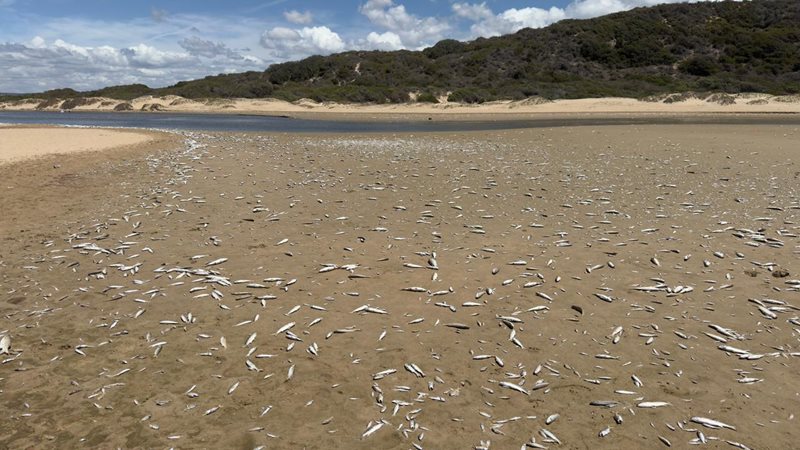
MOSSEL BAY NEWS - Thousands of dead fish from the Hartenbos River washed up along the Hartenbos Lagoon yesterday morning, 2 January.
Drone Fanatics SA captured video footage and photographs of the masses of dead fish along the shoreline earlier today.
Phillip Vermaak, the chairperson of the River Forum, told Mossel Bay Advertiser that he had already been out to the scene today, 3 January and spoken with authorities who arranged with a contractor for a clean-up of the fish.
Vermaak said the death of thousands of fish from the Hartenbos River is expected to repeat every few years, whenever there is a heatwave due to how shallow the river currently is.
He said there were a few factors that would have contributed to the deaths but the main one is that the river has gone from 1.9 mean level to 0.7.
Vermaak said he took a reading near the surface of the river yesterday afternoon, 2 January and in some of the shallower parts it was 34 degrees Celsius.
Drone Fanatics SA captured this footage of the dead fish along the shoreline
He said the water in deeper parts was 24 degrees Celsius yesterday evening. Vermaak said these temperatures are for tropical fish, not the fish in the Hartenbos River.
Vermaak added that whenever there is a heatwave, the high temperatures cause the sludge and algae in the water to bloom, a process called eutrophication. This rids the water of oxygen and causes the fish to suffocate and ultimately die.
He said the shallowness of the water adds to the rapid heating of the river.
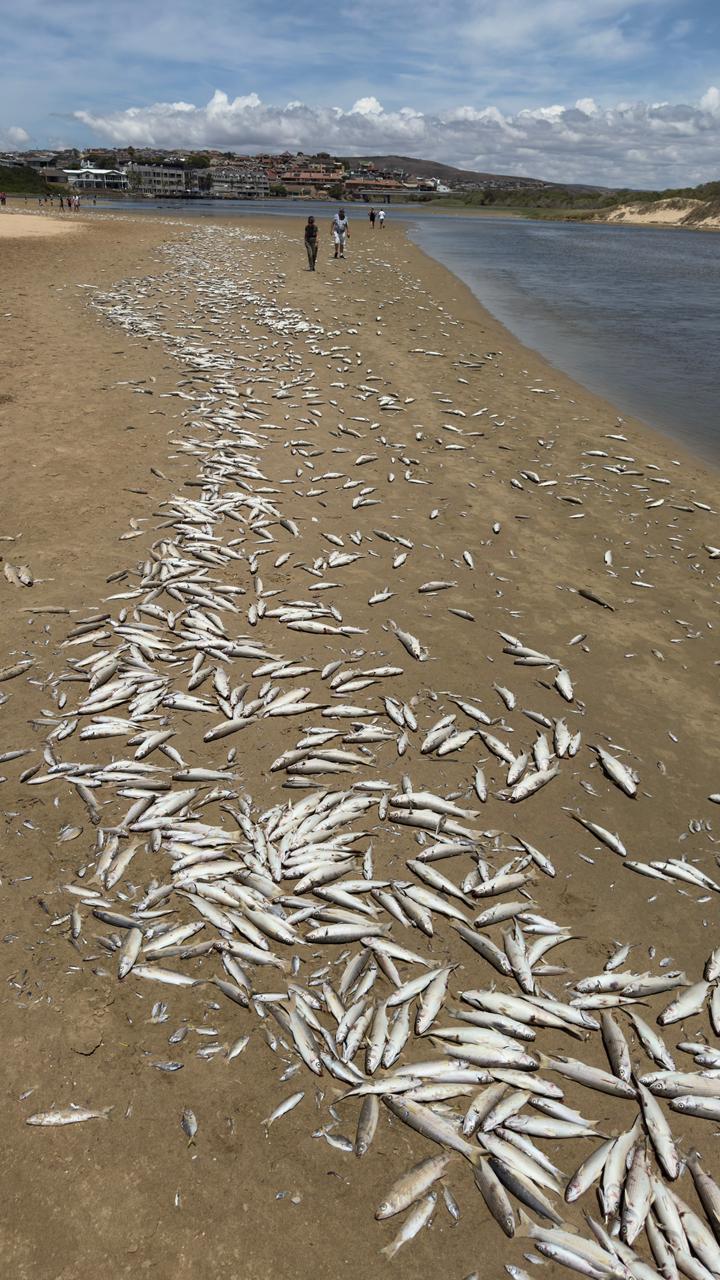 The dead fish washed ashore this morning, 3 January. Photo: Drone Fanatics SA
"The only solution I see is to dredge the river and make it deeper," he said.
The Mossel Bay Municipality said on a post on its Facebook page that it is aware of dead fish that washed up at the mouth of the Hartenbos River.
It said in a post today that scientific observations have confirmed that the fish kill resulted from severe oxygen depletion within the estuary.
"The oxygen deficit was caused by an algal bloom, exacerbated by a combination of low water levels, elevated temperatures, and nutrient-rich conditions - all factors known to accelerate oxygen consumption and create hypoxic conditions," it said.
Questions have been sent to the Western Cape Department of Forestry, Fisheries and the Environment. It's response will be added as soon as it is received.
‘We bring you the latest Garden Route, Hessequa, Karoo news’