

Video
MOSSEL BAY NEWS AND VIDEO - Dana Bay Conservancy’s wildlife camera trap initiative, which was started in July last year, is paying off spectacularly with the gathering of data on Dana Bay’s wildlife and its behaviours.
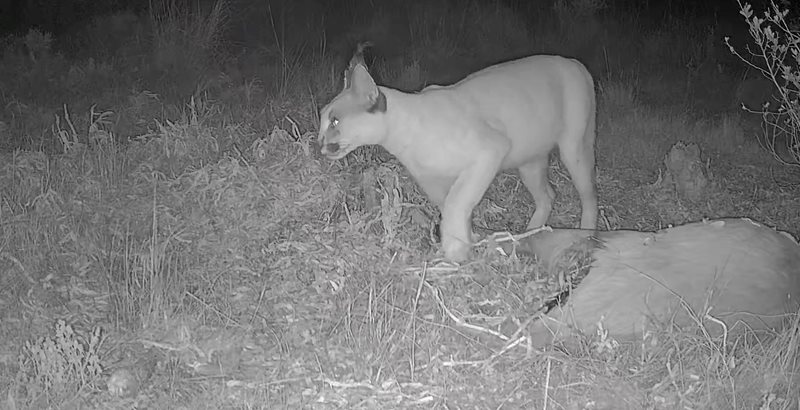
The camera traps, which have been set up in some green belts in the Dana Bay area and are being run in partnership with the Wildlife Crime Information Network (WCIN), recently caught a female caracal feasting on a small male Cape bushbuck carcass for four nights.
On the fifth night, a honey badger was captured on the camera trap scavenging off the carcass.
Dana Bay Conservancy chairperson Erika van der Westhuizen said one of the reasons for installing the camera traps was to observe the behaviour of wildlife, and use the information in conservation efforts.
“Ultimately, we want to keep data that could assist us in the future in making better conservation decisions by using it to our advantage. This became a reality on 29 January,” she said.
At 07:00 that morning, the conservancy received an alert of a small antelope that a caracal had killed the night before. Van der Westhuizen said the conservancy has become familiar with the bite marks and eating patterns of caracal in the area, as there have been a few caracal kills of wildlife over the last few months.
VIDEO: Dana Bay Conservancy captured this footage on one of the camera traps. Video: Dana Bay Conservancy
“Previously, we or the public would contact the Mossel Bay Municipality to come and remove the carcass, hopefully the same day,” she said.
“Unfortunately, the smell of a carcass can become nauseating after a few days. These carcasses would then be disposed of at the municipal dumps. But this time we moved quickly and relocated the dead bushbuck deeper into the green belt and immediately installed one of our camera traps. What we saw over the next few nights was just utterly amazing.”
The caracal came back again to eat the carcass over the next three nights. “Every night she would, after eating, try to hide the carcass by using her paws to move twigs, leaves and grass to cover/hide her prey. This behaviour made us realise that if we removed her prey, she probably would have hunted again and possibly killed another buck.”
On the fifth night after the caracal’s kill, a honey badger was captured scavenging off the remains of the carcass, which by this stage was mostly bones.
Van der Westhuizen said during the day, flies and maggots covered the carcass, and this drew in birds, which ate the maggots and other insects on and around the remains.
“Nature took its course, ensuring that very little was left behind. This way, no diseases will spread, the animals are fed, and the balance in nature is maintained. The ecosystem will remain healthy.”
Van der Westhuizen added that the conservancy also recently signed an agreement with the Gouritz Cluster Biosphere Reserve (GCBR) for it to capture the data on the conservancy’s behalf, which will be used to draw up reports and maps.
If you would like to support the conservancy or sponsor a camera trap, WhatsApp the conservancy on 067 490 8396.
Previous articles:
- New initiative to help collect data on Dana Bay wildlife
- A closer look at Dana Bay wildlife
- Cape genet spotted on Dana Bay camera trap
‘We bring you the latest Garden Route, Hessequa, Karoo news’