

ELECTION NEWS - The ANC secured 3 246 council seats and 30.76% of the vote in South Africa’s 2026 local government elections, retaining its position as the largest party nationally.
The DA finished second with 24.64% and 1 695 seats, followed by the MK Party with 9.76% and 785 seats.
Independent Electoral Commission (IEC) chairman Mosotho Moepya announced the results at the National Results Operations Centre in Midrand on Sunday evening, 8 November, declaring the elections free and fair.
Results had been concluded for 212 of the country’s 213 municipal councils. The outstanding result is for Siyancuma Municipality in the Northern Cape, where a revote will be held at a Douglas voting station after ballot papers were destroyed before counting could start.
How the seats are shared
The EFF received 6.22% of the vote and secured 588 council seats, while ActionSA obtained 5.67% and 313 seats.
Together, the five leading parties secured 6 627 council seats. Other political parties and independent candidates collectively received 22.97% of the vote.
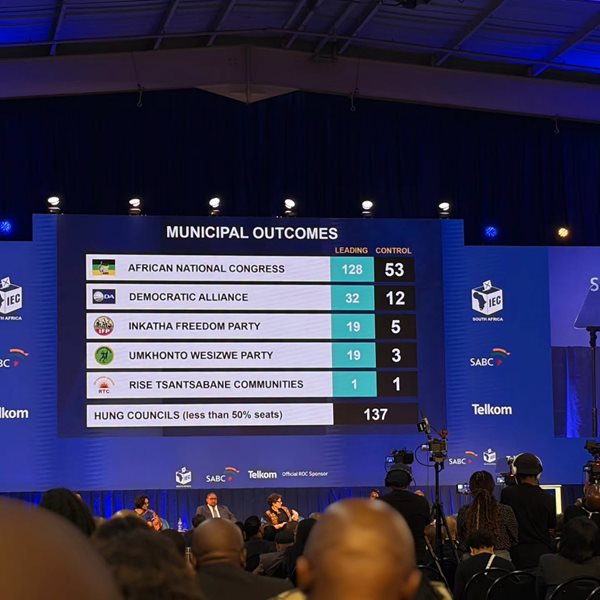
The ANC achieved outright control in 53 municipalities and is the leading party in 128. The DA secured outright control in 12 municipalities and leads in 32.
The IFP achieved outright control in five municipalities and is the leading party in 19. The MK Party secured outright control in three municipalities and leads in 19.
Moepya said 74 councils have a party with an outright majority.
Where no party holds an outright majority, parties will need to negotiate arrangements for coalitions to establish municipal governments.
Ward, proportional and district seats
He outlined a municipal representation system comprising 10 526 council seats.
These include 4 485 ward seats and 4 340 proportional representation seats.
There are 707 district council seats allocated through the 40% proportional representation component. A further 994 district council seats, or the remaining 60% of district representation, will be filled through the nomination of councillors by local municipalities.
The turnout in the election was 52%, up by 6.1% from the 45.9% recorded in the 2021 municipal elections. There were 29.2 million registered voters.
Douglas voters to return to polls
Moepya said political party activists had stormed a voting station in Douglas, in Siyancuma Municipality, and destroyed ballot papers before they could be counted. The IEC will withhold the municipality’s results pending a revote at the affected station.
He said electoral legislation provided for a revote where ballot papers had been lost, destroyed or unlawfully removed before counting.
Councils must serve residents
In his address, President Cyril Ramaphosa urged political leaders to put service delivery ahead of positions and power when forming municipal governments.
“The stability of our municipalities cannot be sacrificed to narrow political interests. The delivery of essential services cannot be held hostage by political disagreements.
“Our people do not judge government only by the promises that are made or the policies that are adopted. They judge government by what changes in their daily lives.”
He said South Africans want to live better and to see their lives go forward.
“They want jobs and they want opportunities. They want water to come from their taps and electricity that works. They want their refuse collected, their parks maintained and their streets safe.”
Voters express confidence
Moepya said an election-day survey by the Human Sciences Research Council found that 95% of voters were satisfied with the services provided by the IEC.
The survey rated the freeness and fairness of the elections at 91% and trust in the commission at 81%. It also found that 91% of voters had queued for no longer than 30 minutes.
He thanked electoral staff, voters, parties, independent candidates and observers, while acknowledging that the commission needed to learn from its shortcomings.
He credited more than 6 000 observers from 121 organisations for the elections.
‘We bring you the latest Garden Route, Hessequa, Karoo news’