


NATIONAL NEWS - For farmers in the Garden Route and Klein Karoo, South Africa’s looming exclusion from a major American trade agreement may seem a world away. But even those who never export a single box of fruit to the United States could feel the effects.
The United States announced on Monday 2 November that South Africa would lose its benefits under the African Growth and Opportunity Act (Agoa) from 1 January 2027.
The decision has raised concerns about agricultural exports, particularly citrus, and the jobs that depend on them.
But what exactly is Agoa, and should Southern Cape farmers be worried?
What is Agoa?
Introduced in 2000, Agoa allows qualifying African countries to export certain products to America without paying normal import duties.
In simple terms, it makes South African products cheaper and more competitive in the American market.
Without these benefits, American importers will pay additional duties on affected products, potentially making them more expensive than those from competing countries.
However, losing Agoa does not mean South Africa can no longer export to America. It means certain products will become more expensive to sell there.
How much more will farmers pay?
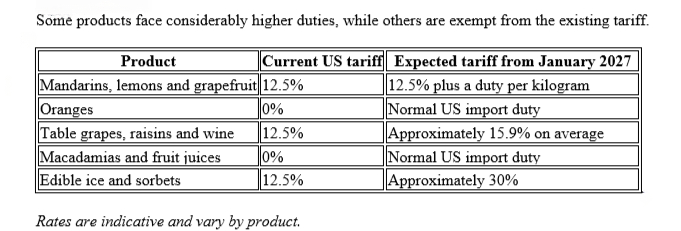
Most affected agricultural products already face a 12.5% American import tariff. Losing Agoa is expected to add approximately 3.4 percentage points on average, although increases will differ between products.
Some products face considerably higher duties, while others are exempt from the existing tariff.
Why citrus growers are worried
South Africa exported a record 203.4 million cartons of citrus in 2025, equivalent to approximately three million tonnes.
Although only 5% to 6% goes to America, this market generates more than US$100 million annually.
The Citrus Growers’ Association chairperson, Gerrit van der Merwe, has warned that jobs could be lost, particularly in citrus-producing communities such as Citrusdal.
Many orchards were developed specifically for American buyers. Redirecting fruit elsewhere is not straightforward because countries have different requirements for varieties, sizes, packaging and plant-health standards.
If exporters cannot sell profitably in America, they may have to accept lower prices or redirect fruit to other markets, potentially pushing prices down there too.
Smaller and emerging farmers, already operating on tight margins, are particularly vulnerable.
While the additional cost may be relatively small for the agricultural sector as a whole, in a citrus-producing town it could determine whether a packhouse can afford to operate a second shift.
 Photo for illustration purposes: Pexels
What about the Southern Cape?
The immediate impact on Garden Route and Klein Karoo farmers is expected to be smaller than in major citrus-producing regions.
Local agriculture includes dairy, avocados, berries, kiwifruit, hops, honeybush and ostrich farming.
Much of this production is sold locally or exported to Europe, the United Kingdom and other markets rather than America.
Ostrich producers around Oudtshoorn have some direct exposure to American tariffs, but the greater regional concern is the possible knock-on effect.
If fruit originally destined for America is redirected to Europe, increased competition could put pressure on prices, affecting Southern Cape exporters who do not trade directly with America.
Packing facilities, transport operators and other businesses that depend on agricultural exports could also feel the pressure.
Is there any good news?
Agricultural economists believe the overall impact on South Africa’s farming sector will be manageable.
In 2025, agricultural exports reached a record US$15.1 billion, of which approximately US$504 million went to America, representing just 3% to 4% of the total.
South Africa has also expanded access to alternative markets, including improved citrus access to India, new arrangements with China and an agreement allowing table grapes into South Korea.
African countries are increasingly important customers.
However, finding replacement buyers takes time, and new markets may not offer the same prices.
What should farmers do?
Farmers should establish whether their products reach America directly or through marketing agents, and review agreements to determine who will carry additional tariff costs.
Exporters should investigate alternative markets, while growers planning new orchards should consider varieties suitable for several destinations rather than one.
Can the decision change?
South Africa has a 60-day window before the removal takes effect.
Trade Minister Parks Tau has indicated that the government intends to challenge the decision and seek a negotiated solution.
The American administration cited trade barriers, corruption and national security concerns among its reasons.
Until 1 January 2027, farmers should prepare for the possibility that the decision will stand, while the government continues efforts to have it reversed.
South Africa’s farming sector has previously adapted to tariffs as high as 30%, suggesting that the latest adjustment may be manageable, although not without consequences.
For Southern Cape farmers, the immediate threat may be limited, but the broader message is clear: even those who do not export to America are not necessarily protected from decisions made in Washington.
Sources: Congressional Research Service (Agoa background); US Trade Representative (trade policy); Citrus Growers' Association of Southern Africa (citrus exports and industry impact); agricultural economist Wandile Sihlobo (tariff analysis); Business Day (agricultural export figures); and reporting by Daily Maverick, Freight News, Moneyweb, Mail & Guardian and BusinessTech.
‘We bring you the latest Garden Route, Hessequa, Karoo news’