



Update
GEORGE NEWS - Justice has finally been served for the family of Joan Singrew (53) after her estranged husband, Duane Singrew (47), was sentenced to life imprisonment in the George Circuit High Court earlier today, Friday 10 April, for her murder.
His cousin, Heinrich Jumat (46), who was convicted as an accomplice, received a 20-year prison sentence.
Jumat chose not to testify and had remained extremely quiet throughout the trial.
In an incident during proceedings, a member of the public standing near the steps leading to the accused dock slipped a package, believed to be marijuana, to Jumat.
Court officials quickly intervened, confiscated the substance, and removed the individual from the courtroom.
'Main culprit', Duane Singrew
In respect of accused number one, Singrew, Judge André le Grange had considered the nature and seriousness of the offence and the interests of the public, finding no justification for deviation from the prescribed minimum sentence.
The defence had argued that a toxic home environment contributed to the circumstances leading up to the murder.
The judge described the circumstances as deeply troubling.
Singrew and Joan were still living in the same home and remained connected through family ties. Le Grange said that Joan was described as a kind and loving person who had begun taking steps to regain control of her life.
She had initiated divorce proceedings and obtained a protection order against her husband. Despite this, her life was taken by the person from whom she sought protection.
He said Singrew was reportedly unhappy that Joan had entered into a new relationship and was unwilling to divide the estate equally. He himself had relationships and affairs, yet objected to Joan pursuing her own life independently.
His messages to her were described as crude and vulgar, and her decision to take legal action appeared to have enraged him.
To make matters worse, evidence was led showing that Singrew and Jumat discussed setting the body alight in an attempt to destroy or disguise evidence, demonstrating that they would do whatever is necessary to disguise the evidence.
Evidence was also led regarding the unbearable pain inflicted on Joan's family members.
The judge described the offence as a brutal and callous act, an extreme manifestation of gender-based violence. National statistics on femicide remain alarming, and gender-based violence continues to be one of the most pressing issues in society.
Le Grange questioned what could have led to the incident, noting that jealousy could have served as a motivating factor, but there was no evidence of provocation or a loss of control in the heat of the moment.
However, he said, there was a sustained pattern of abuse, no remorse, and no acceptance of responsibility or acknowledgement of harm caused. The toxic nature of the relationship did not excuse or justify the killing.
Le Grange concluded that Singrew’s personal circumstances did not constitute compelling or substantial circumstances warranting deviation from the prescribed minimum sentence. The principle of proportionality was considered throughout.
Silent accomplice, Heinrich Jumat
In respect of Jumat, accused two, who sat quietly during proceedings, Le Grange said he had an extensive criminal record spanning from 1998 to 2021.
While not the mastermind and not involved in planning or executing the killing, Jumat's participation was nonetheless considered critical. The court noted he was no stranger to disregarding the law.
Jumat was sentenced to 10 years imprisonment on the charge of defeating the ends of justice. On the charge of murder, he was sentenced to 15 years imprisonment, of which five of the 10-year sentence will run concurrently. He will serve 20 years direct imprisonment.
Duane's cousin from Great Brak River, Rosco, who appeared in court as a witness, was indemnified from prosecution. He had testified Duane had planned to retrieve Joan's body from the embankment and burn it.
He also told the court that he saw what appeared to be a woman's legs protruding from a bag in Duane's car on the day that they disposed of the body.
'Justice has been served'
Following sentencing, Joan’s daughter, Monique van Beulen, stated: “I feel relief, but it will not bring my mother back. I am satisfied with the outcome of the sentence, although this was a very sad and difficult case for all involved. Justice has been served for the children and the family. We can now begin to move forward and take each day as it comes.
“I hope that one day he will find it in his heart to show remorse to his children and family.
“I would like to thank Advocate Evadné Kortje, the community, our family and friends, everyone who supported us, as well as the investigating officer, the police, and all the court officials.”
In her victim impact statement earlier this week, Van Beulen described how what was once a happy home had been reduced to a place marked by trauma, saying they are now living in what feels like a crime scene.
Despite their pain, she said the family has chosen to forgive Duane and pleaded with him to make peace with the Lord for the sake of his two minor daughters that he shared with Joan. Van Beulen will now raise these two girls along with her own daughter.
Case proven beyond reasonable doubt
Le Grange handed down the sentence after the two men were found guilty in March of murder and defeating the ends of justice.
The court heard that Joan was murdered at her home in Rosemoor in November 2024. Her body was found on 25 November, the day she would have celebrated her birthday. She had bruises around her neck, arms and head, and her body had been discarded like trash down a bushy embankment in Charles Street in Great Brak River.
According to witness testimony during trial, Duane planned to return to the scene later to burn her body in an attempt to get rid of any evidence. He, however, never had the opportunity.
The State’s case relied heavily on forensic evidence, including blood and DNA linking Joan to Duane’s vehicle, as well as technological data confirming his movements on the day of the murder. CCTV footage also played a key role in reconstructing events.
Joan was strangled following a violent assault, after which her body was loaded into the boot of Duane’s car and dumped.
The state prosecutor, Advocate Evadné Kortje (SC), argued that the case had been proven beyond reasonable doubt, a position the court upheld.
Advocate Johan Visser (SC) appeared for the defence.
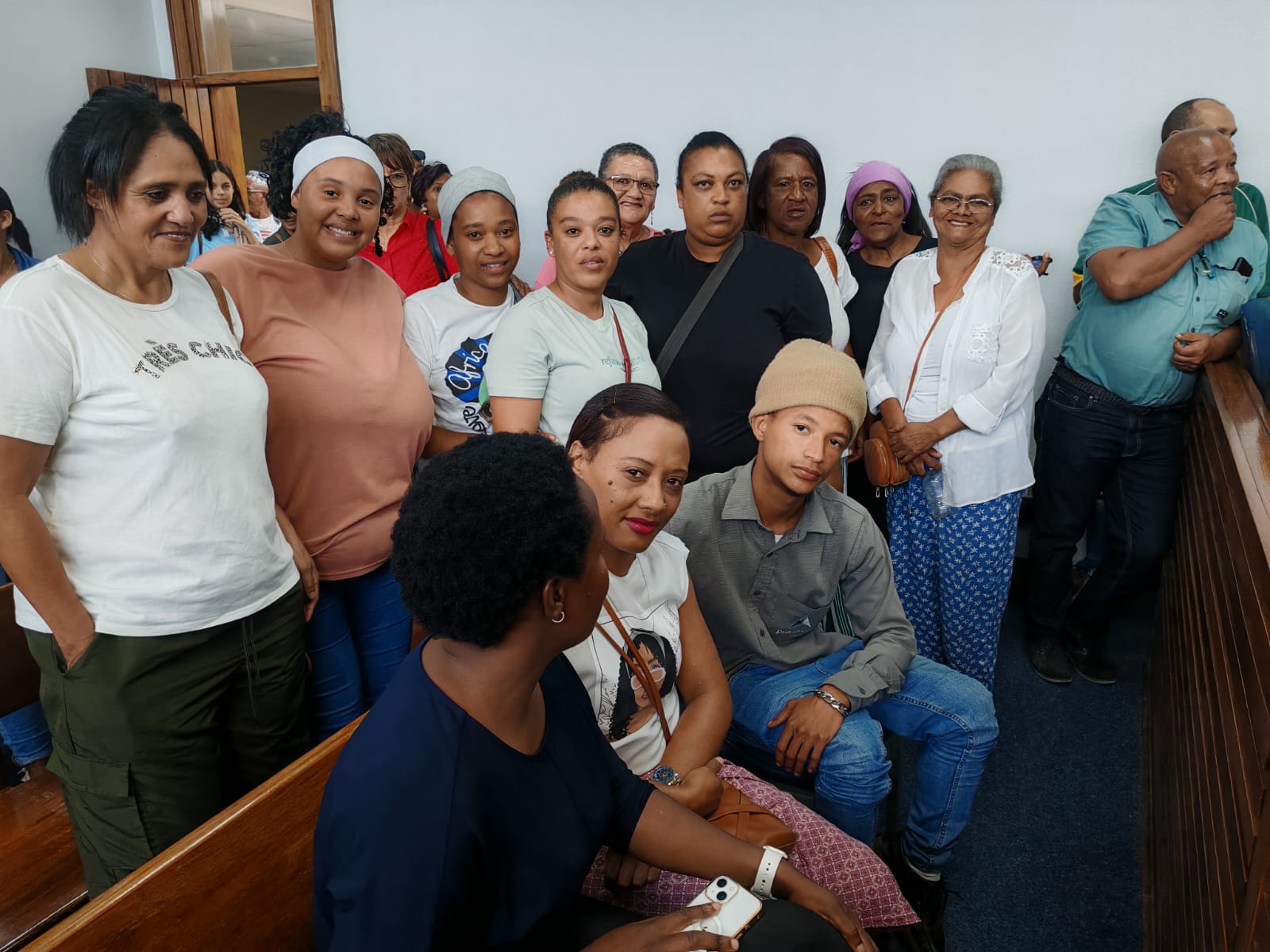 Joan Singrew's daughter, Monique van Beulen (seated in the middle) with a group of supporters and family members. Photo: Marguerite van Ginkel
Previous articles:
- Singrew-moord: Arrogante moordenaars wys middelvingers vir familie
- Joan Singrew-moord: man en neef môre gevonnis
- Duane Singrew guilty of murdering his wife
- Singrew-moord: Man en neef skuldig bevind
- Singrew-moord: Ford Figo en bloedspore sentraal in staat se saak
- Slotbetoë wag in Singrew-moordsaak
- Joan Singrew murder: Husband's movements scrutinised
- Man getuig oor sy bewegings toe Joan Singrew verdwyn
- Joan Singrew murder trial: Accused brings application for discharge
- Joan Singrew murder: CCTV evidence presented
- Geweld voor Joan se dood
- Joan Singrew murder trial starts in high court
- Joan Singrew-moordverhoor begin eersdaags
- Joan Singrew murder: Two suspects arrested
- Body found on birthday
- Familie bevestig liggaam van Groot-Brak is dié van Joan Singrew
- Vrou se lyk op Groot-Brak gevind
- George woman reported as missing
‘We bring you the latest Garden Route, Hessequa, Karoo news’