

MOSSEL BAY NEWS - Maroné Vosloo (53) started writing to help others understand ADHD, but in the process, developed a better understanding of herself, too.
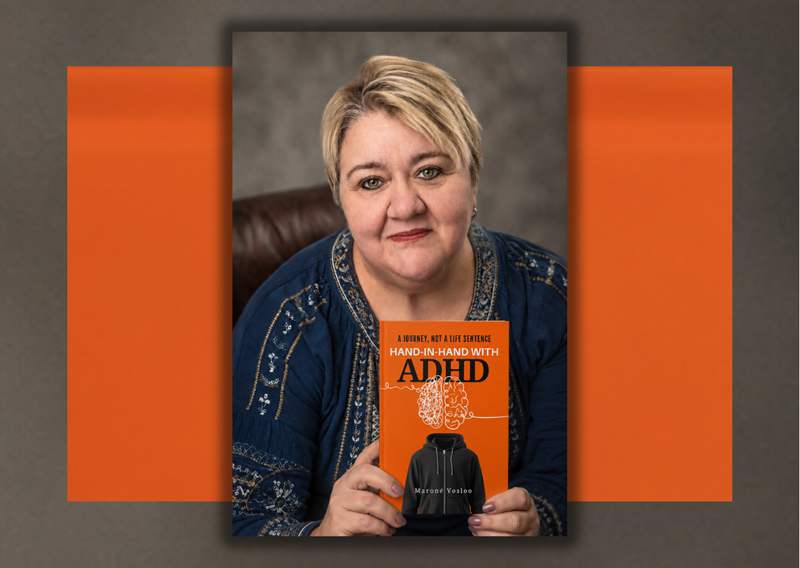
Through this process of working towards understanding, her book, Hand-in-hand with ADHD: A Journey, Not a Life Sentence, was born.
And on Friday 15 May, friends, family and book lovers alike gathered for the official release in Mossel Bay, where she had a book discussion with Hannes Visser of Kersligmedia, her publisher.
Finishing this book was her own miracle - the journey up to this point had not been an easy one. In 2023, Vosloo became a part of the statistics of women who are diagnosed with ADHD later in life.
ADHD, or attention-deficit/hyperactivity disorder, is far more than simply being hyperactive or distracted, says Vosloo. “It can affect emotions, memory, focus, relationships, self-esteem, sensory processing, and even the ability to cope with everyday life.”
Road to ADHD diagnosis
Vosloo works in debt collection and credit control, an extremely emotionally demanding job.
It was an incident at work that led to her official ADHD diagnosis, Vosloo says. “My daily reality is dealing with people who are already angry before I even answer the phone or they walk through my office door. After three particularly traumatic physical incidents, I eventually reached a point where I simply could not cope anymore. My workplace referred me to a counsellor, but I ultimately found myself seeking support from a psychiatrist as well. That is where I became part of the statistic.”
From there, as is her nature, she deep-dived into ADHD research and completed a course in neuroscience and an ADHD coach certification. She has also completed a pastoral narrative therapy course through Caritas Care, accredited with the University of Pretoria.
“It gave me a wide range of knowledge, but the biggest part of my understanding of ADHD comes from my own lived experience. After my diagnosis, it felt like, suddenly, a string of lights along a dark passage had been switched on. Things that have been stumbling blocks my whole life began to make sense.”
This deepened her compassion for others who are silently struggling, especially those living with ADHD, anxiety, emotional overload or burnout. “Sometimes people carry invisible battles while still showing up every day, doing their jobs, smiling, and trying to stay strong.”
Writing a book
But one doesn’t simply wake up one day and start writing a book - especially if, like Vosloo, you’ve never really had that inherent love of writing. “At school, I didn’t even want to write my own essays if it wasn’t necessary!” she laughingly admits.
The seed was planted at a Warrior Bride Camp she attended with a friend. Here, she says, she received a prophecy that she would heal people.
“My first thought was that it meant physically sick people, but I immediately thought, no way, that is not my calling. Then, almost instantly, I felt the answer clearly in my heart: not physically sick people, but people with ADHD. The message was simple: Write a book.
“I simply emptied my heart out. When the manuscript felt ready to me, I sent it to two publishers. Within days, Hannes contacted me and said he wanted to publish my book.”
Behind the (writing) scenes
Vosloo says she has always been more of the type to draw pictures, design things and be creative visually.
“One day I wondered, if I had to write [this] book, what would the cover look like? So I designed a cover - and I actually thought it looked pretty cool.
“Then I thought to myself, while I’m busy with this, where would I even begin [to write]? So I started typing.”
And once she started, it just kept coming. She planned, built the skeleton, and before she knew it, she was completely hyperfocussed. “I would forget to eat, drink water, or even go to the bathroom until it became necessary. Sleep barely existed. Sometimes I slept only two hours a night.
My husband [Nel] would say goodnight while I was sitting in front of my computer, and in the mornings, he would say goodbye while I was still sitting there, writing.”
Altogether, the process took almost a year. “My mind was overflowing with ideas, emotions and stories that I desperately wanted to tell, but organising all of those thoughts was often challenging. There were moments in which writing felt almost magical because of the intense hyperfocus, and other moments where exhaustion, self-doubt and emotional and sensory overload made the process feel impossible.”
Despite the challenges, Vosloo says the process taught her to embrace the way her mind works and to realise that her neurodivergence is not a limitation, but part of the unique voice behind her story.
Healing
Vosloo’s hope is that her book reaches many people so it can have the same healing effect for them as it did for her. “Through writing it, I realised that healing can happen when people finally feel understood, seen, accepted and less alone. Sometimes it begins the moment someone realises they are not broken simply because they are different.”
So what can the reader expect inside the cover of Hand-in-hand with ADHD?
“This book is about being human and the quiet battles someone with ADHD faces in a world that is not always designed for neurodivergent minds.
“It speaks not only to people with ADHD, but also to those who love, support, teach or work alongside them.
“It offers honest insight into the chaos of a racing ADHD mind, emotional intensity, sensory overload, the exhaustion of constantly trying to cope, and also the unique brilliance, creativity, passion and deep empathy that often come with ADHD.”
She says at the same time, it brings hope as well as practical tools.
The bug has bitten
“Writing this book changed me in ways I never expected. Putting everything into words forced me to slow down and really reflect on my own experiences, struggles, emotions, and the ways ADHD has shaped my life.
“For many years, I viewed parts of myself as ‘too much’, ‘not enough’ or ‘different in the wrong way’. I think I came out on the other side with far more self-awareness, self-compassion and acceptance.”
Now that the writer’s bug has bitten her, she said her next book, The Marriage Re-write, is already taking shape.
This one is about learning to think differently about your marriage, seeing your spouse through fresh eyes, and handling challenges in a healthy way.
“One of the biggest things I discovered through this process is that I express myself far better through writing than through speaking. When I write, I have the time and space to process my thoughts, organise my emotions, and say exactly what I mean.
“Spoken words can sometimes feel rushed, overwhelming, or incomplete - especially with an ADHD mind that often moves faster than the mouth can keep up.”
Home and ADHD awareness
When she’s not writing or working, Vosloo is a real homebody. “I am happily married to my dear husband, and we live in Dana Bay. We are both introverts and, as I always jokingly say, we enjoy getting our money’s worth from our rent.”
Apart from her full-time job, she also runs a small design business and is involved in counselling. Together with a friend, she helped establish an ADHD support group in Mossel Bay.
“Supporting neurodivergent individuals and creating awareness around ADHD has become something very close to my heart, both personally and professionally.”
ADHD advice
Having gone through all of this, Vosloo has some advice for those who suspect they may have ADHD, but don’t quite know where to start.
Naturally, she recommends her book as a start, and completing some of the basic ADHD questionnaires and self-assessment tools available. “Often, people are surprised by how many of the symptoms, emotions, struggles and experiences they deeply resonate with. Sometimes that first moment of recognition can already bring a sense of relief and understanding.
“The next thing I would say is: do not be too hard on yourself. Many people spend years feeling ‘lazy’, ‘too emotional’, ‘too much’, or as if they are constantly failing, without realising there may be an underlying reason.
“If you suspect you may have ADHD, start educating yourself from trustworthy sources and learn more about how ADHD actually presents - especially in adults and women, where it is often misunderstood or missed completely.
“I would also encourage people to speak to a qualified professional who truly understands ADHD. A diagnosis is not about putting a label on yourself; it is about gaining understanding, clarity, and the right tools to help you navigate life in a healthier way.
“And lastly: do not walk the journey alone. Find support, whether through counselling, support groups, loved ones or communities where people truly understand what you are going through. Feeling seen, heard and understood can be life-changing.”
For any enquiries about her book or support group, contact Vosloo on 083 884 9398.
‘We bring you the latest Garden Route, Hessequa, Karoo news’