

LIFESTYLE NEWS - For people living with chronic kidney disease, healthcare is about much more than what happens during a dialysis session.
It is also about how they feel, how well they are able to function, how treatment affects everyday life and whether they can continue doing the things that matter to them.
That broader approach to healthcare has earned South African dialysis provider National Renal Care (NRC) a global milestone.
NRC has become the first kidney care organisation in South Africa and globally to achieve Level 1 Enterprise Accreditation from the International Consortium for Health Outcomes Measurement (ICHOM).
The accreditation recognises the organisation-wide implementation of ICHOM’s approach to measuring health outcomes across NRC’s network of 85 units.
Looking beyond clinical measurements
Traditional healthcare measurements remain important, but NRC says they do not always capture the full experience of living with kidney disease.
Through the ICHOM approach, NRC measures outcomes relating to patients’ health, wellbeing, functioning, symptoms, treatment experience and quality of life alongside clinical outcomes.
Dr Chevon Clark, chief executive officer of National Renal Care, says the accreditation represents an important step towards continuously improving the quality of renal care.
“For people living with chronic kidney disease and receiving dialysis, this means measuring a wider range of indicators to better understand the outcomes that shape a person’s everyday life beyond treatment alone.”
The approach forms part of NRC’s move towards value-based healthcare, where the quality of care is increasingly considered in terms of the outcomes achieved for patients.
“Our responsibility extends beyond delivering dialysis safely and effectively. We need to understand whether the care we provide is improving the outcomes and quality of life that matter to our patients,” Clark says.
Giving patients a greater voice
NRC says consistently measuring patient-centred outcomes can also help people receiving renal care become more active participants in their healthcare.
The organisation already provides digital support through its NRC app, which includes access to medical records as well as tools for exercise, meal planning, nutritional information, fluid-intake tracking and symptom monitoring.
The addition of structured outcome measurements provides another way of bringing the patient experience into conversations about care.
“Over time, consistently measuring and using outcomes can support more meaningful conversations between patients and their healthcare teams, ensuring shared decision making and a greater focus on what each patient values most,” Clark says.
Understanding life beyond dialysis
Kidney failure can have a significant impact on everyday life, with dialysis becoming an essential part of a person's routine.
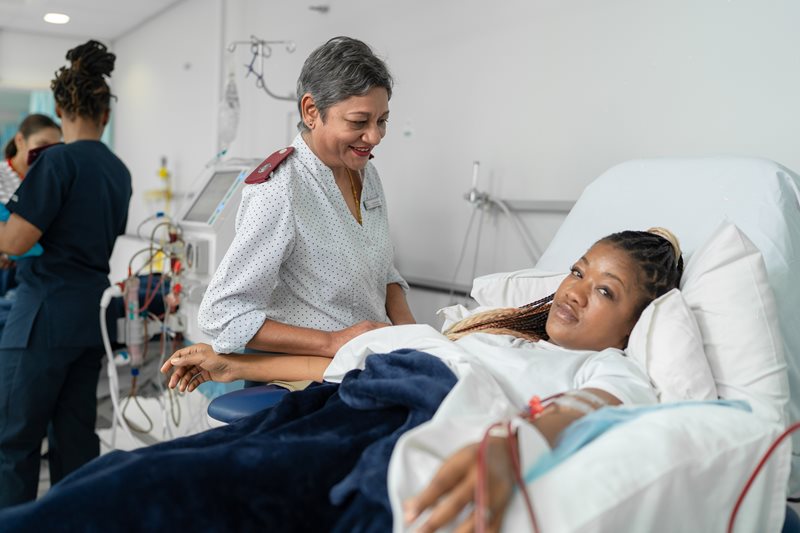
NRC centres provide dialysis and related support to people living with kidney failure, including in-centre haemodialysis, home haemodialysis and peritoneal dialysis, as well as pre-dialysis education and support.
Dialysis performs some of the functions normally carried out by healthy kidneys by filtering the blood and removing waste and excess fluid.
For patients, however, successful treatment is only one part of the picture.
Measuring quality of life and other patient-reported outcomes can help healthcare teams understand how treatment is affecting people outside the clinical setting.
Using data to improve care
ICHOM is an international non-profit organisation established in 2012 to promote patient-centred outcome measurement and enable healthcare providers to benchmark and improve the quality of care.
Its standardised framework gives healthcare professionals a way to combine clinical information with outcomes from the patient's perspective.
“ICHOM provides a globally standardised framework through which we can bring the patient’s voice together with clinical outcomes. For healthcare professionals, this creates an opportunity to learn from our data and continually improve care,” Clark says.
NRC's accreditation reflects the work of multidisciplinary teams across its network, as well as the participation of patients in measuring the outcomes that matter to them.
Clark says the organisation is particularly grateful to patients who have embraced the opportunity to become active participants in the process.
A focus on living well
Ultimately, the goal is not simply to measure more.
It is to use what is learned to help people living with kidney disease enjoy a better quality of life.
“We are deeply invested in helping the people we care for feel well enough to make more happy memories with their loved ones and to enjoy life to the fullest for many years to come,” Clark says.
For NRC, the global accreditation is therefore being positioned not as an endpoint, but as a foundation for ongoing improvement.
“We see this accreditation as a catalyst for ongoing innovation that truly extends the possibilities for a better life for every patient,” Clark says.
‘We bring you the latest Garden Route, Hessequa, Karoo news’