

Update
MOSSEL BAY NEWS - Aalwyndal, at one stage viewed as one of the possible main urban expansion areas for Mossel Bay, seems to be in a sort of development deadlock.
A biodiversity study that commenced in May 2024 stands at the centre of this issue - and residents say they can't seem to find concrete answers to their residential and development future.
The draft biodiversity study of the Aalwyndal area was released last August, but the Mossel Bay Municipality's Council deferred it about two months later, which means it currently has no formal status.
Aalwyndal, which is over 600ha, had been earmarked for possible development in the municipality's Spatial Development Framework (SDF) of 2018 and 2022.
However, following several site-specific studies by owners, sensitivity mapping and the biodiversity study, the area was found to have some environmentally sensitive sections that could influence future development plans the municipality, owners or any developers might have.
Five reports
This draft study consists of five reports, titled as follows:
• Revision of the Aalwyndal Precinct Layout
• Calculated Size and Characteristics of the Offset
• Costed Conservation Management Plan for the Onsite Biodiversity Offset
• Identification, Ground-truthing and Feasibility of Potential Offsite Offsets
• Management and Financial Arrangements for Biodiversity Offsets.
In short, these deal with the balance between the conservation and development of the area. One main aspect is that of "offsets".
The municipality formerly defined this process, "Environmental offsets basically facilitate the development of sensitive vegetation in one area (for instance, Aalwyndal) in exchange for protection of the same vegetation type in a better suited location further away from development pressures where the conservation can be implemented in a more sustainable way."
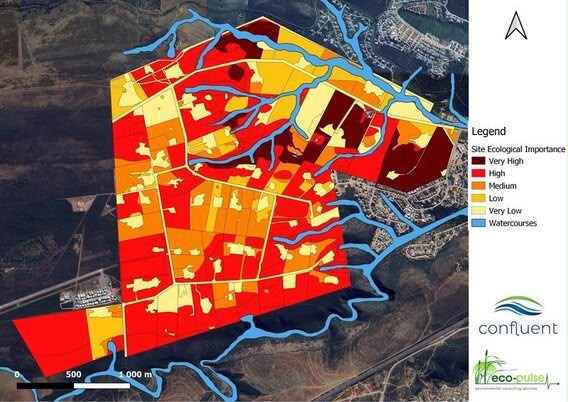 A map that forms part of the draft biodiversity study, indicating the site ecological importance of Aalwyndal. The brownish-maroon areas are of very high importance, and red of high importance. Photo: Mossel Bay Municipality
Council resolution
A long-awaited public participation meeting followed a few weeks after the study's release, which resulted in the Council deferring it by way of a motion of exigency.
In it, the Council resolved:
• to acknowledge that the plan has no legal standing in current planning processes.
• to note the dissatisfaction expressed by residents regarding the consultation process.
• to direct that no municipal endorsement or implementation of the plan or its financial and land use mechanisms will occur at this stage.
• to encourage the consultants and the provincial department to engage meaningfully with affected landowners before any further steps are taken.
Despite these resolutions, however, the residents still feel like they're living in development darkness.
Various engagements with the public have taken place over the last few months, the most recent held in Aalwyndal on Monday 21 September.
Willing to participate
A representative for the residents and landowners, who requested anonymity, told Mossel Bay Advertiser that they are not against any future development of Aalwyndal, nor are they against the municipality's conservation efforts; they only wish to be included in ongoing discussions with the municipality and the Department of Environmental Affairs and Development Planning (DEADP), as they fear they will be blindsided by decisions of which they were no part, nor had any knowledge.
They said in the past, they had received vague feedback from the municipality and the DEADP regarding the study's status and the way forward.
At Monday's meeting, the residents met with the municipality's senior town planner, Jaco Roux, the director of planning and economic development, Carel Venter, and Ward 7 councillor Stephan Botha.
Here, the residents learnt there had been a few meetings between the municipality and the department over the last few months.
The municipality had hoped to come to a compromise with the department on the study and its findings; however, the DEADP instead told it that further studies of the area by experts would have to be paid for from the municipality's pocket, which it said was not possible.
Red tape
The delayed finalisation of this study has prevented landowners from using the proposals in the documents to facilitate offsets.
When residents questioned how the offset study came about in the first place, as it was the first to cover such a large area with so many landowners, they were told it was done in the hopes of reducing red tape.
Roux said that when the municipality had identified the area for development, the department came on board saying they wanted to assist to fast-track the project and reduce red tape by initiating a study on a large scale, as it felt individual offsets on a per-development basis would have been impractical and a source of frustration and confusion for authorities, landowners and developers alike.
It was also intended to produce a Strategic Biodiversity Offset Framework Plan specifically for Aalwyndal.
Municipality responds
In response to a query the Advertiser sent on Friday 4 September, the munici-pality said it has engaged in ongoing communication with the residents.
The main message communicated to the landowners, said the municipality, was that those who wish to develop their properties must submit the necessary development and Environmental Impact Assessment (EIA) applications to the DEADP, the municipality and other relevant authorities.
"The detailed studies undertaken as part of these processes will determine the sensitivity status of the applicable property and will be considered during the decision-making process."
It added that although the biodiversity study currently has no formal status, some of the information it contained may still be relevant to specific properties.
DEADP responds
The DEADP's head of communications, Rudolf van Jaarsveldt, said considerations regarding the biodiversity study are required in certain instances in which unavoidable residual impact on the surrounding areas is to be addressed, as part of the necessary processes to grant or obtain additional land use rights.
He added that a strategic approach is being followed to ensure that sustainable development will be pursued.
Van Jaarsveldt stressed that work on the biodiversity study is not yet complete, and that the submitted comments have informed the ongoing processes.
Uncertain future
As matters stand, it is still unclear what the way forward is and if the biodiversity study will be reworked following the Mossel Bay Municipal Council's deferral.
Both the municipality and the DEADP say another public participation meeting is being considered, but has not yet been finalised.
Previous articles:
- Aalwyndal development: Residents seek clarity, date
- Development of Aalwyndal: certain areas 'highly sensitive'
- Aalwyndal development: biodiversity study released
- Questions and concerns raised in public participation meeting
- Aalwyndal: 4 things you need to know
‘We bring you the latest Garden Route, Hessequa, Karoo news’